Apply Virtual Card
Async card-open endpoint. A successful response means "queued"; the final result is pushed via card.opened / card.open_failed webhook or polled via card/info.
Endpoint
| Item | Value |
|---|---|
| Method | POST |
| Path | /api/v1/openapi/card/apply |
| Auth | HMAC |
| Idempotency Key | Required via Idempotency-Key header |
Request Fields
Don't send card_type
This endpoint does not accept card_type. The server derives it from header_id and verifies it's within the virtual-card range.
| Field | Type | Required | Description |
|---|---|---|---|
header_id | string | ✅ | hdr_<id> (List Card Headers) |
package_id | string | ✅ | pkg_<id> (List Card Configs) |
first_name | string | ⚠️ | Cardholder first name (depends on header.require_phone/email) |
last_name | string | ⚠️ | Last name |
phone_code | string | ⚠️ | Country code (e.g. 86 / 1) |
phone | string | ⚠️ | Phone number (without country code) |
email | string | ⚠️ | |
use_bound_email | bool | No | Default false — server uses the email you sent. Set true to fall back to the account's bound email. |
use_bound_phone | bool | No | Default false — server uses the phone + phone_code you sent. Set true to fall back to the account's bound phone. |
cardholder_id | string | ⚠️ | chd_<id> of a cardholder approved for the header's card type. Required on every virtual_v / virtual_r / virtual_g / virtual_a / virtual_s921 header (all have cardholder_required=true on List Card Headers, v1.6.8) — without it the request is rejected with cardholder_required before any funds are frozen; ignored on virtual_l / virtual_p headers. When it is used, the holder fields above are ignored — see Opening with a cardholder |
billing_address | object | No | Billing address for a card opened without a cardholder (v1.6.6) — since v1.6.8 only on virtual_l / virtual_p headers. The same object as billing_address on /cardholder/create (country / state / city / line1 / postcode required, district / line2 optional). When sent, the card is opened with it and it becomes the card's billing_address (source=platform); when omitted, the platform generates the card's billing address as before. Ignored when a cardholder_id is used, i.e. on every virtual_v / virtual_r / virtual_g / virtual_a / virtual_s921 header. See Billing address without a cardholder |
first_deposit_amount | string | No | Custom total first deposit, non-negative integer (pay/recharge asset unit, e.g. USDT). Empty = config base. Must be ≥ the package's min_first_deposit (List Card Configs); when that minimum is above base, this field is required (the empty default is rejected with first_recharge_below_min). The part above base is charged a recharge-style fee and frozen alongside the open fee. Dry-run the exact numbers with Preview First Deposit. |
When holder fields are required
- If
header.require_phone == true: sendphone_code+phone(or setuse_bound_phone == trueto fall back to the account's bound phone) - If
header.require_email == true: sendemail(or setuse_bound_email == trueto fall back to the account's bound email) first_name/last_nameare usually required (thevirtual_g/virtual_a/virtual_s921rules below applied to cards opened without a cardholder)- Since v1.6.8 every
virtual_v/virtual_r/virtual_g/virtual_a/virtual_s921header requires acardholder_idand the cardholder's data is used, so none of the holder fields are needed there — they only matter onvirtual_l/virtual_pheaders (see Opening with a cardholder) - OpenAPI default differs from the H5 app:
use_bound_phoneanduse_bound_emaildefault tofalsehere — the server uses what you sent. Merchants normally don't have bound phones/emails on our side, so falling back to bound values would fail. Sendtrueonly if you have a verified reason to read the bound value.
Cardholder name and billing address after opening
Cardholder details are sent to the issuer once, at apply time — the issuer-registered details cannot be changed after the card is opened. What you can read and change afterwards via Cardholder Name & Billing Address is the platform's record (card_holder_name and billing_address), which is not sent to the issuer. Keep the name you submitted at apply time in your own system. For a card opened without a cardholder (since v1.6.8 only on virtual_l / virtual_p headers) the billing address is part of those details: send the one you want as billing_address at apply time (v1.6.6, see Billing address without a cardholder).
When the card is opened with a cardholder_id, the platform record starts with the cardholder's full_name as card_holder_name. When the cardholder has a billing address (country / state / city / line1 / postcode), billing_address is that address (source=cardholder) and is read-only (see Platform record vs. issuer record); otherwise the platform generates the card's billing address as for a card opened without a cardholder. Since v1.6.8 the platform no longer requires a billing address on every cardholder: whether the header needs one — like every other material, country or residence restriction — is decided by the issuer's precheck before any funds are frozen (cardholder_requirements_unmet).
Custom first deposit
By default a card opens with the config's base initial deposit. To top it up, send first_deposit_amount (a non-negative integer ≥ base). The base is credited 1:1 with no fee; the excess above base is charged a recharge-style fee, the remainder is credited 1:1 (USDT/USD, no FX), and the first deposit sent to the provider is rounded to an integer. The open fee + the full computed freeze are held from your wallet at apply time.
A package may also enforce a minimum first deposit above the base (min_first_deposit in List Card Configs, min_first_deposit_amount in the preview). In that case first_deposit_amount is required and must be ≥ that minimum; only the base part stays fee-free (e.g. base 10, minimum 500 → deposit ≥ 500, 10 fee-free, 490 charged).
Preview before applying
The validation (format / >= base / minimum first deposit / max recharge / balance) is shared with Preview First Deposit. Call the preview first to show the customer the exact total_freeze / first_recharge_card — the numbers match this endpoint 1:1. Invalid amounts are rejected here with the same keys the preview reports as invalid_reason (see Common Errors). The one check the preview does not run is the account's recharge limit: apply can still reject with first_recharge_limit_exceeded.
Virtual-G specific constraints
Cardholder required since v1.6.8
Every virtual_g header now requires a cardholder_id: the cardholder's data is used and the request's holder fields are ignored. The constraints below applied to cards opened without a cardholder and no longer apply to new applications; they are kept for reference.
virtual_g (G card) has extra constraints enforced server-side beyond what header.require_* may say:
| Constraint | Rule | Failure error_key |
|---|---|---|
| Always required (server overrides header) | bank_card_email_required | |
| Phone | phone_code + phone always required (server overrides header) | bank_card_phone_required |
| Cardholder name | first_name + last_name combined must match ^[A-Za-z]+(?: [A-Za-z]+)*$ and total length ≤ 40 chars (ASCII letters only; single-space separators; no digits, symbols, or non-ASCII) | virtual_g_name_invalid |
| Date of birth | Not collected | virtual_g_required_fields_missing (rare; platform configuration) |
| Billing address | Optional billing_address (v1.6.6); when omitted, the platform generates the card's billing address as before | the cardholder_* address keys listed in Billing address without a cardholder |
Trim and validate the name before calling apply
Many real-world cardholder names contain accents, hyphens, or apostrophes — those are rejected by the provider. Inform end users that G-card applications require an ASCII-letter-only name with single-space separators.
Virtual-A specific constraints
Cardholder required since v1.6.8
Every virtual_a header now requires a cardholder_id: the cardholder's data is used and the request's holder fields are ignored. The rules in the table below applied to cards opened without a cardholder and no longer apply to new applications; they are kept for reference.
virtual_a (A card) belongs to the same card family as V / R / G and has its own application rules. The server enforces these rules regardless of what header.require_* says — and the header list already reports the effective values (require_email=true, require_phone=false) for A-card headers:
| Constraint | Rule | Failure error_key |
|---|---|---|
Always required — send email (or use_bound_email=true if the account has a bound email) | bank_card_email_required | |
| Phone | Not collected — phone_code / phone / use_bound_phone are ignored; this card type does not collect a phone number | — |
| Cardholder name | first_name and last_name are both required and must be non-blank (whitespace-only values are rejected); checked before any funds are frozen | virtual_a_required_fields_missing |
| Date of birth | Not collected | virtual_a_required_fields_missing (rare; platform configuration) |
| Billing address | Optional billing_address (v1.6.6); when omitted, the platform generates the card's billing address as before | the cardholder_* address keys listed in Billing address without a cardholder |
Everything else (custom first deposit, idempotency, async result via card.opened / card.open_failed, recharge, freeze / unfreeze, close, transactions, sensitive card info) works exactly as for the other virtual card types.
Virtual-S921 specific constraints
Cardholder required since v1.6.8
Every virtual_s921 header now requires a cardholder_id. The rows below that describe opening without a cardholder (name / email / phone, billing address) no longer apply to new applications and are kept for reference; the header / currency rule and the behavioural differences still apply.
virtual_s921 (S921 card, USD virtual card) belongs to the same card family as V / R / G / A and, since 2026-10-30, can also be opened with a cardholder (cardholder_id; the cardholder is used for association and checks only). Without a cardholder:
| Constraint | Rule | Failure error_key |
|---|---|---|
| Cardholder | Required cardholder_id (v1.6.8: the issuer discontinues issuance without a cardholder on 2026-12-01 and the platform already applies this to every header) — without it the request is rejected with cardholder_required before any funds are frozen. The same checks apply as for the other card types | cardholder_required; see Opening with a cardholder |
| Cardholder name / email / phone | All optional — the card can be issued without them. header.require_email / require_phone are always false for this type | — |
| Date of birth | Not collected | — |
| Billing address | Optional billing_address (v1.6.6) | the cardholder_* address keys listed in Billing address without a cardholder |
| Header / currency | The header must be fully configured on the platform and the package currency must be USD (platform configuration; nothing to do on the merchant side) | virtual_s921_required_fields_missing |
Behavioural differences:
Opening usually completes synchronously: in most cases
card.openedarrives within seconds of acceptance; when the provider cannot confirm in-request the card stayspending(1)and is finalised automatically after roughly 10 minutes — the result is still delivered viacard.opened/card.open_failed.The card number (PAN) can arrive after the card is opened: the card may already be
active(2)— andcard.openedmay already have been delivered — before the issuer releases the card number. The platform fetches it automatically, usually within seconds and at most about 90 seconds later. Until then:masked_card_no/last_fourare empty strings in/card/infoand/cards/list, andcard.openedcarries nolast_four;/card/infowithwith_sensitive=truemay return emptycard_number/cvv/expiry;/card/rechargeis rejected witherror_keycard_number_not_ready(HTTP 200,code40000) — nothing is frozen; retry later with a newIdempotency-Key.
Poll
/card/infountilmasked_card_nois non-empty before topping up or handing the card to the cardholder.Recharges settle asynchronously: usually within seconds; the balance is unchanged until then and
card.rechargedis authoritative.Closing goes through a clearing period: the card becomes unusable immediately and enters
closing(4); the balance is settled andcard.closedis delivered after a clearing period of about one day — that wait is not an error.
Billing address without a cardholder
Only virtual_l / virtual_p headers since v1.6.8
Every virtual_v / virtual_r / virtual_g / virtual_a / virtual_s921 header requires a cardholder_id, so on those headers the cardholder's billing address is always used and billing_address is ignored. This section therefore only applies to virtual_l / virtual_p headers.
Since v1.6.6 a card opened without a cardholder can carry the billing address you choose: send billing_address and the card is opened with that address — it is part of the details submitted at apply time (see Platform record vs. issuer record) and becomes the card's billing_address (source=platform, still editable afterwards). When you omit the field, the platform generates the card's billing address as before.
| Card opened… | billing_address sent | Result |
|---|---|---|
| without a cardholder | yes | the card is opened with your address; it is the card's billing_address on /card/info (source=platform, editable) |
| without a cardholder | no / null / empty object | as before: the platform generates the card's billing_address in the header's issuing region |
with a cardholder_id that is used for the header | any | the cardholder's billing address is used; billing_address in the request is ignored (source=cardholder, read-only) |
Whether a header uses cardholders is supported on /cardholder/requirement; on virtual_l / virtual_p headers a cardholder_id is ignored anyway, so billing_address always applies there.
Fields — the same object as billing_address on /cardholder/create. Since v1.6.8 this address is validated more strictly than a cardholder's address (which only gets the issuer's format and length baseline), because no header requirement applies to it: the five parts below are required and the character / postcode rules apply. The cardholder_address_incomplete / cardholder_address_line_invalid / cardholder_postcode_invalid keys are only returned for this address:
| Field | Required | Rule | error_key on failure (data.field) |
|---|---|---|---|
country | ✅ | ISO 3166-1 alpha-2 (e.g. SG; upper-cased by the server). Any country / region is accepted (v1.6.7): the header's support_billing_region concerns cardholders and is not checked here | cardholder_country_code_invalid (billing_address.country) |
state | ✅ | ≤ 20 characters, no control characters | cardholder_field_too_long / cardholder_address_line_invalid (billing_address.state) |
city | ✅ | ≤ 70 characters, no control characters | same (billing_address.city) |
district | as city | same (billing_address.district) | |
line1 | ✅ | ≤ 70 characters; only English letters, digits, spaces and , . ' / # ( ) - & | cardholder_field_too_long / cardholder_address_line_invalid (billing_address.line1) |
line2 | as line1 | same (billing_address.line2) | |
postcode | ✅ | 4–10 letters or digits, spaces / hyphens allowed in between (e.g. 048616, SW1A 1AA; upper-cased by the server) | cardholder_postcode_invalid (billing_address.postcode) |
- An object that is not empty but misses any of
country/state/city/line1/postcodeis rejected withcardholder_address_incomplete(data.field=billing_address). An object whose fields are all empty or blank counts as omitted. - The server trims and collapses whitespace and upper-cases
country/postcode. - All checks run before any funds are frozen: no card is created and nothing is frozen when they fail. Errors come back as
code=40000with a top-levelerror_keyanddata.field(see Error details). They cover format and required fields only — the platform applies no country restriction to this address (v1.6.7); if the issuer rejects the application, the open fails and the frozen funds are returned. Idempotency-Keycovers the whole request body: retrying the same key with a differentbilling_addressreturns409 openapi_idempotency_key_conflict. Use a new key to apply with another address.- The card's
streeton/card/infoisline1,line2anddistrictjoined with,(empty parts skipped). - The other rules of the card type still apply (e.g. the holder fields required by
require_phone/require_email).
To prefill a plausible address, call /cardholder/billing_address/random with the target header_id (and optionally country): it returns this exact object shape — in the country you pass, otherwise preferably in the header's issuing region — and its address lines pass the character rules.
{
  "header_id": "hdr_5",
  "package_id": "pkg_12",
  "first_name": "John",
  "last_name": "Smith",
  "email": "[email protected]",
  "phone_code": "65",
  "phone": "81234567",
  "billing_address": {
    "country": "SG",
    "state": "Singapore",
    "city": "Singapore",
    "line1": "1 Raffles Place",
    "line2": "Unit 2001",
    "postcode": "048616"
  }
}Once the card is opened, /card/info returns billing_address = { "country": "SG", "state": "Singapore", "state_full_name": "Singapore", "city": "Singapore", "street": "1 Raffles Place, Unit 2001", "zip_code": "048616", "source": "platform", ... }.
Opening with a cardholder
Every virtual_v / virtual_r / virtual_g / virtual_a / virtual_s921 header (cardholder_required=true on List Card Headers) can only be opened for a registered cardholder whose review for the header's card type is approved — and, when the header has kyc_required=true on /cardholder/requirement, who has passed the identity verification that header requires. Register and review the cardholder first (Cardholders guide); /cardholder/check tells you per header whether the cardholder is ready (eligible=true).
The issuer discontinues card issuance without a cardholder_id on 2026-12-01 (every card BIN); the platform already applies this since v1.6.8: on these headers a request without cardholder_id is rejected with cardholder_required (HTTP 200, code 40000) before any funds are frozen — no card is created. With a cardholder_id, if the issuer cannot currently provide the header's requirements (requirement_available=false on /cardholder/requirement), the request is rejected with cardholder_requirement_unavailable (50000), also before any funds are frozen.
| Item | Rule |
|---|---|
| Which cardholders | Only cardholders registered through OpenAPI on your account. Another account's cardholder, or one created in the App / Web, returns HTTP 404 cardholder_not_found |
| Data used | The cardholder's first_name / last_name, email, area_code / mobile_number, date of birth and billing address (when it has one). first_name / last_name / email / phone_code / phone / use_bound_email / use_bound_phone in the request are ignored, and the G / A card name rules below do not apply (the issuer checks the cardholder's data against the header's requirements) |
| No optional headers | Since v1.6.8 every virtual_v / virtual_r / virtual_g / virtual_a / virtual_s921 header requires a cardholder_id, whatever the issuer's registration_required on /cardholder/requirement says |
| Not used | On virtual_l / virtual_p headers a cardholder_id is ignored (a malformed value is still rejected with openapi_invalid_cardholder_id) |
| Reuse | One cardholder can open any number of cards, up to the header's max_cards_per_cardholder (Cardholder Requirement) |
| Timing | The cardholder checks run before any funds are frozen: after the local checks the platform prechecks the cardholder with the issuer for this header (the same rules as card issuance — materials, country lists, identity verification, review status, card limit). Whether the materials are sufficient (including the billing address) is decided only by this precheck — the platform adds no requirements of its own (v1.6.8). If the issuer cannot be reached, the decision falls back to the stored review status (the latest status is fetched once first) |
{
  "header_id": "hdr_5",
  "package_id": "pkg_12",
  "cardholder_id": "chd_1024"
}Rejections and their structured data (see Error details):
| error_key | data | Meaning |
|---|---|---|
cardholder_required | — | No cardholder_id was sent (required on every virtual_v / virtual_r / virtual_g / virtual_a / virtual_s921 header); no funds were frozen |
cardholder_not_registered | — | The cardholder is still a draft |
cardholder_manual_review_pending / cardholder_manual_review_rejected | — | The cardholder is under platform manual review / did not pass it (since v1.6.10); no funds frozen and no review submitted |
cardholder_review_not_approved | review_status (NOT_SUBMITTED / PENDING_REVIEW / REJECTED / COVERAGE_INSUFFICIENT), failure_reason when rejected, terminal: true on a final rejection | The review for this card type is not approved, or the reviewed information does not cover this header (submit again) |
cardholder_kyc_level_not_passed | header_id | The identity verification this header requires has not been passed — start it with this header_id (data.level is no longer returned) |
cardholder_requirements_unmet | header_id, issues[], missing_fields[] (same shape as /cardholder/check) | The issuer's precheck found materials or restrictions that this header does not accept — fix them with /cardholder/update and submit again |
cardholder_card_limit_reached | — | The cardholder already holds max_cards_per_cardholder cards on this header |
cardholder_kyc_not_configured | — | The header requires identity verification but it is not configured yet — contact us |
cardholder_requirement_unavailable | — | (code 50000) The header's cardholder requirements are temporarily unavailable — retry later |
cardholder_header_bin_missing / cardholder_header_bin_unavailable | — | The header is not linked to an issuer card BIN, or the issuer has disabled that BIN — choose another header or contact us |
cardholder_provider_status_not_allowed | — | The issuer's precheck says the cardholder's current status does not allow opening a card — refresh with /cardholder/detail (refresh: true) or contact us |
cardholder_provider_unavailable | — | (code 50000) The issuer's precheck returned a result that could not be interpreted — retry later |
bank_card_apply_cardholder_requirements_unmet | — | The issuer found that the cardholder does not meet the header's requirements (missing information, country restriction, or the cardholder's card limit on this header). The frozen funds are returned; run /cardholder/check to see what is missing |
bank_card_apply_cardholder_disabled | — | The cardholder cannot be used to open cards at the moment; the frozen funds are returned — contact us |
The issuer can also report cardholder_required / cardholder_review_not_approved / cardholder_kyc_level_not_passed / bank_card_apply_cardholder_requirements_unmet itself while the card is being opened; those responses carry no data, and the frozen funds are returned as well.
{
  "code": 40000,
  "message": "This cardholder has not been approved for this card type",
  "error_key": "cardholder_review_not_approved",
  "data": { "review_status": "PENDING_REVIEW" }
}Example Request
On a virtual_v / virtual_r / virtual_g / virtual_a / virtual_s921 header (cardholder required):
{
  "header_id": "hdr_5",
  "package_id": "pkg_12",
  "cardholder_id": "chd_1024"
}On a virtual_l / virtual_p header (no cardholder; send the holder fields the header requires):
{
  "header_id": "hdr_7",
  "package_id": "pkg_15",
  "first_name": "John",
  "last_name": "Doe"
}Required header:
Idempotency-Key: 550e8400-e29b-41d4-a716-446655440000Response Fields
| Field | Type | Description |
|---|---|---|
card_id | string | card_<id> (used for subsequent queries) |
status | int | 1=pending 2=active 3=failed 4=closing 5=closed 6=frozen |
status_desc | string | English description |
created_at | string | RFC3339 timestamp |
Example Response (Queued)
{
  "code": 0,
  "message": "Success",
  "data": {
    "card_id": "card_12345",
    "status": 1,
    "status_desc": "pending",
    "created_at": "2026-04-29T11:00:12Z"
  }
}status=1 doesn't mean ready
status=1 (pending) only means "queued". Wait for the card.opened webhook, or poll card/info until you see status=2 (active).
Subsequent Flow
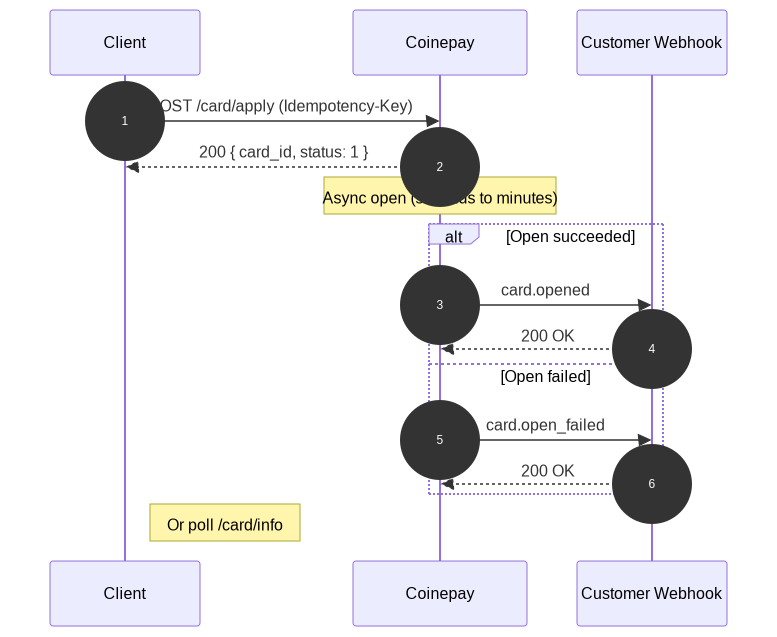
Common Errors
Check code first (0 = success) — business errors come back with HTTP 200 — and branch on error_key. Rejections listed here are detected before any funds are frozen, except virtual_s921_unified_webhook_not_subscribed, bank_card_apply_cardholder_requirements_unmet and bank_card_apply_cardholder_disabled (funds already refunded).
| HTTP | code | error_key | Description |
|---|---|---|---|
| 200 | 40001 | validation_failed | Request body cannot be parsed |
| 200 | 40000 | openapi_invalid_header_id | header_id missing / wrong prefix / not found |
| 200 | 40000 | openapi_invalid_package_id | package_id missing or malformed (expected pkg_<number>) |
| 200 | 40000 | openapi_card_type_not_supported | Header's card type not in the virtual range |
| 200 | 40000 | bank_card_config_not_found | Package not found or inactive |
| 200 | 40000 | bank_card_config_not_available_for_header | Package cannot be used with this header |
| 200 | 40000 | bank_card_header_type_mismatch / bank_card_header_not_found / bank_card_invalid_card_type | Header / package / card type are inconsistent (use values from the list endpoints) |
| 200 | 40000 | open_card_disabled | Card opening is switched off for this card type / header / package |
| 200 | 40000 | card_apply_disabled | Card opening is disabled for your account |
| 200 | 40000 | account_manager_bind_required | Account-manager-controlled header and your account has no account manager bound — only use header_id values returned by /card_headers/list |
| 200 | 40000 | account_manager_unavailable | The account manager bound to your account is no longer active; contact platform support |
| 200 | 40000 | account_manager_open_disabled | Your account manager has not opened this header / package for your account |
| 200 | 40000 | kyc_required | KYC is required for this card and the account has not passed it |
| 200 | 40000 | card_open_risk_blocked / card_open_risk_card_quota_exceeded | Card opening blocked by risk control for this account |
| 200 | 40000 | card_open_limit_daily_exceeded / card_open_limit_monthly_exceeded / card_open_limit_yearly_exceeded / card_open_limit_max_cards_exceeded | Card-opening count limit reached |
| 200 | 40000 | insufficient_balance | Wallet cannot cover open fee + first deposit |
| 200 | 40000 | card_deposit_insufficient_balance | Balance of the deposit asset cannot cover the card-open deposit |
| 200 | 40000 | card_deposit_config_invalid / card_deposit_asset_not_found / card_deposit_already_exists | Card-open deposit configuration problem (platform side) |
| 200 | 40000 | invalid_first_deposit_amount | first_deposit_amount is not a plain non-negative integer (decimals / signs / scientific notation / too many digits) |
| 200 | 40000 | first_recharge_below_base | first_deposit_amount is below the config base |
| 200 | 40000 | first_recharge_below_min | first_deposit_amount (or the empty default = base) is below the package's minimum first deposit min_first_deposit |
| 200 | 40000 | first_recharge_exceeds_max | Excess above base exceeds max_recharge_amount |
| 200 | 40000 | first_recharge_limit_exceeded | Excess exceeds the account's recharge limit |
| 200 | 40000 | first_recharge_asset_mismatch | Open-fee asset ≠ recharge asset; custom excess unsupported for this config |
| 200 | 40000 | first_recharge_excess_too_small | After fee + integer rounding nothing reaches the card; increase the amount |
| 200 | 40000 | first_recharge_rate_unavailable | Exchange rate temporarily unavailable — retry later |
| 200 | 40000 | bank_card_email_required | Card type requires email; send email or set use_bound_email=true (only if the account has one bound) |
| 200 | 40000 | bank_card_phone_required | Card type requires phone; send phone_code+phone or set use_bound_phone=true (only if the account has one bound) |
| 200 | 40000 | virtual_g_name_invalid | (G card) Cardholder name fails ASCII-letters / single-space / ≤40 chars rule. Applies only to issuance without a cardholder, so no longer returned since v1.6.8 |
| 200 | 40000 | virtual_g_required_fields_missing | (G card) Server could not assemble a complete apply payload (rare; platform configuration) |
| 200 | 40000 | virtual_a_required_fields_missing | (A card) The header's platform configuration is incomplete (platform configuration, contact us). The first_name / last_name check applied only to issuance without a cardholder and no longer occurs since v1.6.8 |
| 200 | 40000 | virtual_s921_required_fields_missing | (S921 card) the header is not fully configured on the platform or the package currency is not USD (platform configuration — contact us) |
| 200 | 40000 | virtual_s921_unified_webhook_not_subscribed | (S921 card) the platform-side event subscription for this card type is incomplete; frozen funds have been refunded (platform configuration — contact us) |
| 200 | 40000 | openapi_invalid_cardholder_id | cardholder_id is not a well-formed chd_<id> |
| 404 | 40400 | cardholder_not_found | The cardholder does not exist on your account (or was not registered through OpenAPI) |
| 200 | 40000 | cardholder_required | No cardholder_id was sent on a header that requires one (every virtual_v / virtual_r / virtual_g / virtual_a / virtual_s921 header, cardholder_required=true); no funds were frozen |
| 200 | 40000 | cardholder_not_registered | The cardholder is still a draft |
| 200 | 40000 | cardholder_manual_review_pending / cardholder_manual_review_rejected | The cardholder is under platform manual review / did not pass it; no funds frozen |
| 200 | 40000 | cardholder_review_not_approved | The cardholder's review for this card type is not approved (data.review_status, data.failure_reason, data.terminal) |
| 200 | 40000 | cardholder_kyc_level_not_passed | The cardholder has not passed the identity verification this header requires (data.header_id) |
| 200 | 40000 | cardholder_requirements_unmet | The issuer's precheck rejected the cardholder for this header (data.header_id, data.issues, data.missing_fields); no funds were frozen |
| 200 | 40000 | cardholder_card_limit_reached | The cardholder has reached the card limit on this header; no funds were frozen |
| 200 | 40000 | cardholder_kyc_not_configured | The header's identity verification is not configured — contact us; no funds were frozen |
| 200 | 50000 | cardholder_requirement_unavailable | The header's cardholder requirements are temporarily unavailable — retry later; no funds were frozen |
| 200 | 40000 | cardholder_header_bin_missing / cardholder_header_bin_unavailable | The header is not linked to an issuer card BIN, or the issuer has disabled that BIN — choose another header or contact us; no funds were frozen |
| 200 | 40000 | cardholder_provider_status_not_allowed | The issuer's precheck says the cardholder's current status does not allow opening a card; no funds were frozen |
| 200 | 50000 | cardholder_provider_unavailable | The issuer's precheck returned a result that could not be interpreted — retry later; no funds were frozen |
| 200 | 40000 | cardholder_address_incomplete | billing_address was sent without a cardholder but misses a required sub-field (data.field=billing_address); no funds were frozen — see Billing address without a cardholder |
| 200 | 40000 | cardholder_country_code_invalid / cardholder_address_line_invalid / cardholder_postcode_invalid / cardholder_field_too_long | A billing_address sub-field fails validation (data.field names it, e.g. billing_address.line1); no funds were frozen |
| 200 | 40000 | bank_card_apply_cardholder_requirements_unmet | The issuer rejected the cardholder for this header (frozen funds returned) — see Opening with a cardholder |
| 200 | 40000 | bank_card_apply_cardholder_disabled | The cardholder cannot be used to open cards at the moment (frozen funds returned) — contact us |
| 200 | 50000 | cardholder_service_not_configured | The header needs a cardholder but the cardholder service is not enabled — contact us (nothing frozen) |
| 200 | 40000 | openapi_idempotency_key_required / openapi_idempotency_key_too_long / openapi_idempotency_key_invalid_chars | Idempotency-Key missing / over 128 chars / bad characters |
| 401 | 40100 | openapi_invalid_credentials | Auth failure |
| 409 | 40900 | openapi_idempotency_key_conflict | Same key, different body |
| 409 | 40900 | openapi_idempotency_key_in_progress | A request with the same key is still being processed — retry shortly with the same key |
| 429 | 42900 | too_many_requests | Rate limit hit; honor Retry-After |
| 200 | 50000 | openapi_apply_card_failed | Server error |
Notes
- Open fee + initial deposit are charged / held immediately. With a custom
first_deposit_amount, the excess fee is held too (see Custom first deposit). Failed opens auto-refund. - Async tasks can take a few minutes. Don't retry apply because no webhook arrived in 30 seconds (retries must use the same
Idempotency-Key). - A returned
card_idpermanently identifies the open attempt (even if it ultimately fails).